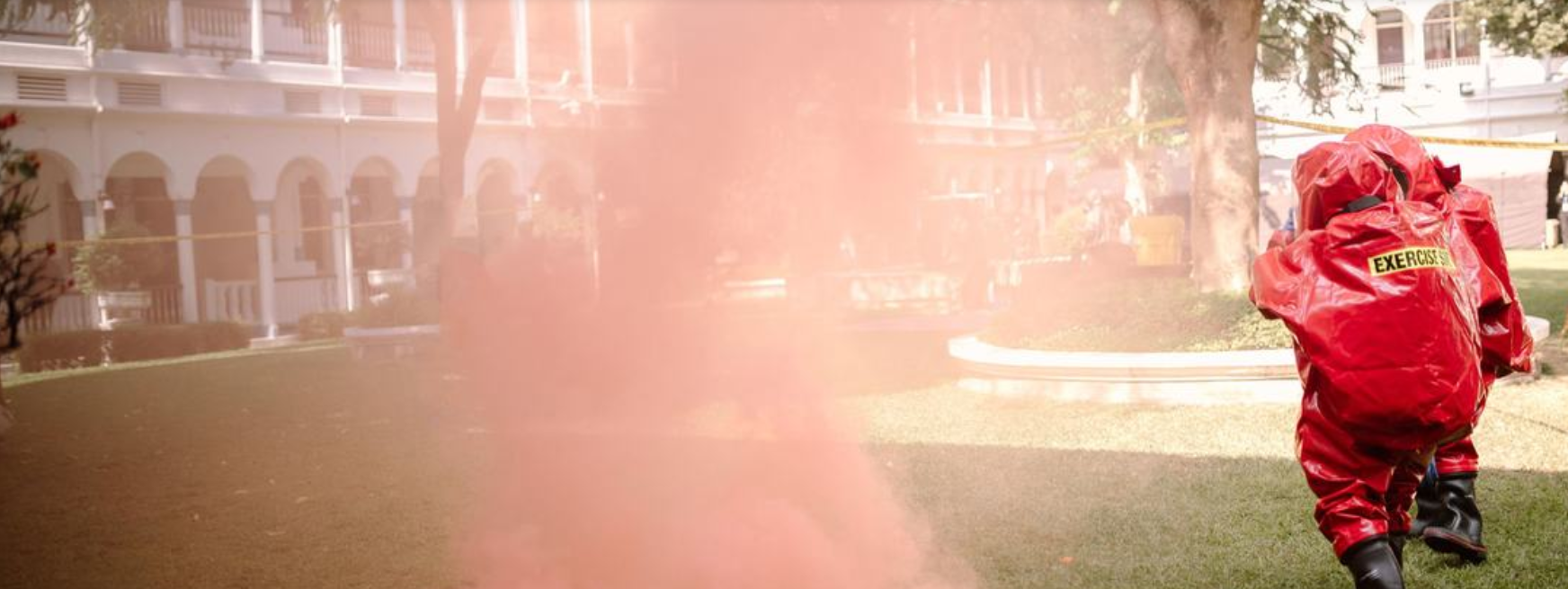
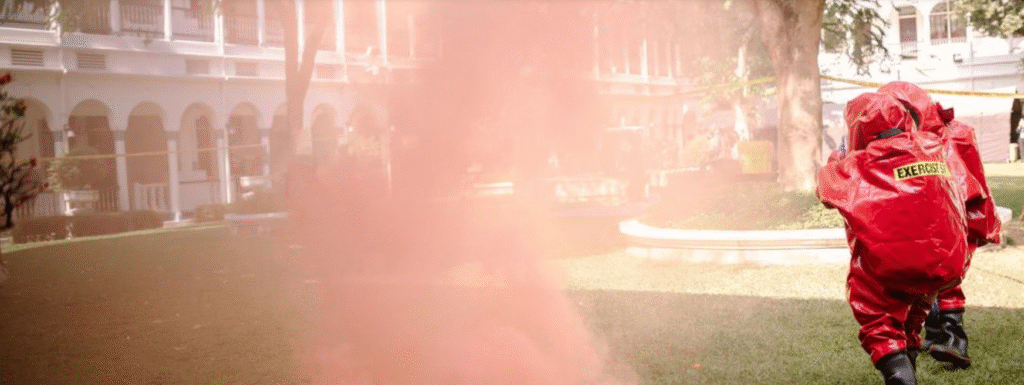
On a seemingly typical day in Semarang, Indonesia, a few train passengers have started to feel nauseous. Others nearby are saying they cannot breathe. Five have fainted. One is not responding. A few minutes in, a miniature car wheezes by them, followed by a group of people dressed in full astronaut-like orange suits. They’re looking for bombs.
This is what a fictional chemical terrorist attack simulation exercise looks like.
“The threat of chemical terrorism is real,” said Niki Esse de Lang, the UN Office on Drugs and Crime, UNODC’s regional counter-terrorism coordinator for Southeast Asia and the Pacific. “To counter it, we need a solid, integrated response by all relevant actors.”
A very real threat
Indonesia is testing its capacity to respond to such threats through simulations, which bring together representatives from government agencies and the private sector.
So far, two have taken place in Semarang over the past months, jointly organised by UNODC and the National Counter Terrorism Agency (BNPT) of Indonesia, with the support of Indonesia’s National Police Mobile Brigade (Brimob-Polri).
Since 2011, at least eight chemical terrorism incidents have taken place in Indonesia, and terrorist groups operating internationally, including ISIL, have used chemical weapons in Iraq and in Syria. In 1995, the toxic chemical compound sarin was used in the Tokyo subway in Japan by members of the Aum Shinrikyo movement, killing 15 people immediately and injuring over a thousand more.
The same chemicals used in legitimate industries, such as mining, agriculture or pharmaceuticals, can also be used by terrorists. Chlorine, for example, commonly used in water treatment facilities, can also produce a chemical weapon.
This complex threat requires strong cooperation between governments and the private sector on the national, regional and international level.
Preparing against chemical terrorism
Outside the train in Semarang, more people in protective equipment have arrived during the training session. The scene is busy. Some are establishing a control area, others are setting up decontamination stations and another group is providing medical aid.
A few are opening tactical laptops and equipment to measure the air and potentially contaminated surfaces, while a team is drawing perimeters on the floor in red, yellow and green, depending on the contamination levels detected.
A miniature car with a sensor and a camera is circulating everywhere, taking samples and helping experts outside the perimeter determine toxicity levels. Nearby, a team dressed in yellow suits is being sprayed by colleagues before breaking out carefully from the thick protective clothing.